> ## Documentation Index
> Fetch the complete documentation index at: https://docs.quanorix.com/llms.txt
> Use this file to discover all available pages before exploring further.
# Generator
> Mass random search, costs, workers, OOS, and live Databank flush.
# Generator
The **Generator** explores strategies at scale (random search by default), evaluates them on your history, and — if enabled — saves them to the **Databank**. Compute runs on your **TPA** (server worker only in special environments); for customer production, assume the TPA is **online**.
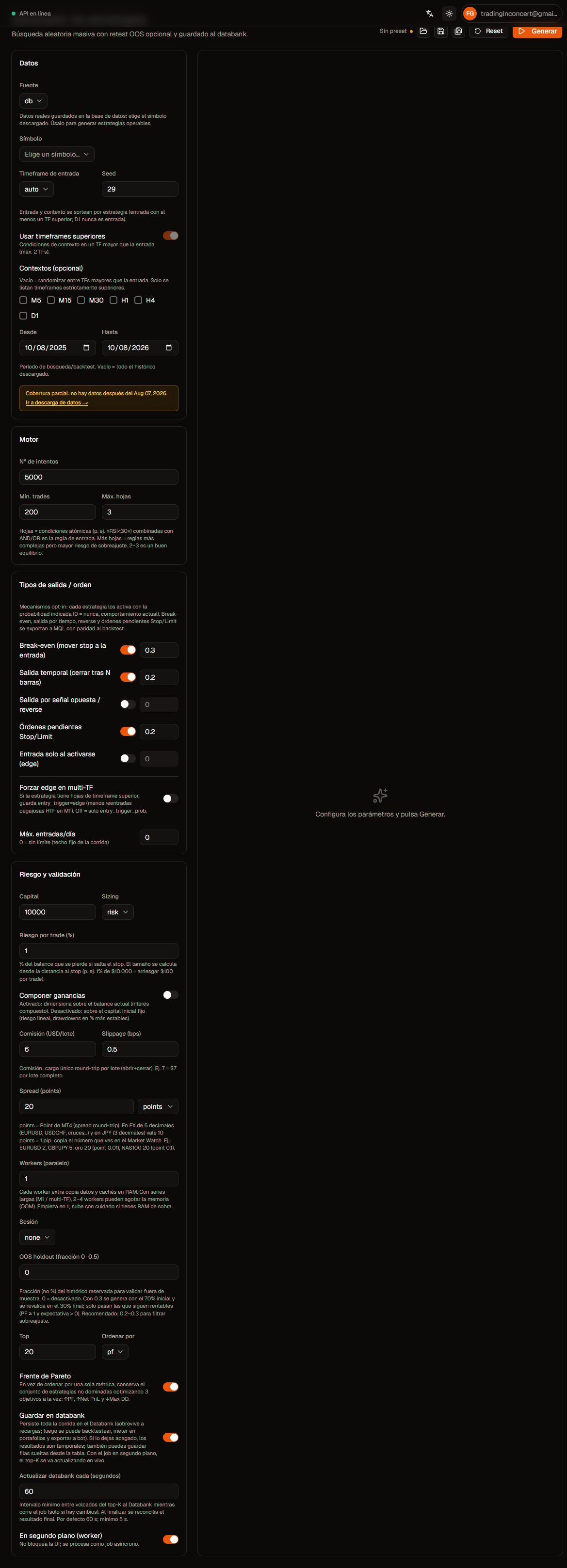 You need a symbol downloaded under [Market data](/en/data/market-data) and a [linked, online TPA](/en/tpa/install). Without data or an agent, the job will not start or enqueue will fail.
## Typical flow
1. Open **Generator**.
2. Pick a **symbol** (already downloaded) and date range (empty = full available history).
3. Set attempts (`n`), risk/costs, and **workers**.
4. Enable **Save to databank** if you want the run persisted.
5. Click **Generate** and follow progress on the page or in **Jobs**.
You can keep navigating — the job runs in the background.
## Data
| Field | Role |
| ----------------- | ------------------------------------------------- |
| Symbol | Must exist in your downloaded datasets |
| Entry timeframe | Fixed or **Auto (randomize)** (D1 is never entry) |
| Higher timeframes | HTF context (max 2 TFs strictly above entry) |
| From / To | IS search window; empty = full coverage |
Partial coverage or a missing symbol is called out in the UI with a link to Data.
## Engine (random search)
* **Attempts**: how many candidate strategies to explore.
* **Min trades / max leaves**: minimum viability and entry-rule complexity.
* Genetic evolution **from an already saved strategy** is done in Databank → **Evolve** (you do not need to invent GP from scratch here). See [Strategy detail](/en/databank/strategy-detail).
## Exit / order types
Opt-in by probability (0 = never):
* Break-even, time exit, reverse / opposite signal
* Pending Stop/Limit orders
* **Entry trigger edge** (false→true pulse) vs re-enter while the signal stays true
* **Force edge on multi-TF** when HTF leaves exist (better MT parity on sticky signals)
* **Max entries/day** (0 = no run-level cap)
These mechanisms export to MQL with backtest parity when applicable.
## Risk, costs, and validation
| Concept | Notes |
| ------------------- | -------------------------------------------------------------------- |
| Capital / sizing | Risk % (from stop) or notional % of balance |
| Compounding | On = size on current balance; off = fixed initial capital |
| Commission | USD per lot round-trip |
| Spread | Points (MT Market Watch style) or bps |
| Slippage | bps |
| Session | All / Asia / London / NY (entry filter) |
| OOS holdout | Fraction 0–0.5 of history for retest; 0 = off. \~0.2–0.3 recommended |
| Top / sort / Pareto | How the top-K is chosen (PF, Net, etc. or Pareto front) |
## Workers and memory (OOM)
**Workers** evaluate in parallel. Each extra worker copies data and caches in RAM. With long series (M1 / multi-TF), **2–4 workers can exhaust memory**.
* Start at **1**.
* Increase only if you have spare RAM and stable runs.
* If the job dies with OOM / process-pool errors, lower workers or shrink range/`n`.
## Saving and live Databank
* **Save to databank**: persists the run (not only temporary on-screen results).
* **Update databank every (seconds)**: incremental top-K flush while the job runs (min \~5 s; default \~60 s). A final reconciliation happens at completion.
* With TPA, mid-run flush also feeds the Databank when agent and job are set up for it.
During an active generation, the Databank may show a live job and refresh on its own.
## Reset and draft
* **Reset** restores generator defaults (does not change global Settings).
* The form draft is stored in the browser **per user**; switching accounts should not inherit another user’s draft.
## Presets and multi-TF
Saving/loading presets and timeframe randomization: [Presets and multi-timeframe](/en/generator/presets-mtf).
## Next
* [Databank](/en/databank/overview)
* [Export bots](/en/export/mt4-mt5)
* [Troubleshooting](/en/troubleshooting) — OOM, stuck jobs, TPA offline
You need a symbol downloaded under [Market data](/en/data/market-data) and a [linked, online TPA](/en/tpa/install). Without data or an agent, the job will not start or enqueue will fail.
## Typical flow
1. Open **Generator**.
2. Pick a **symbol** (already downloaded) and date range (empty = full available history).
3. Set attempts (`n`), risk/costs, and **workers**.
4. Enable **Save to databank** if you want the run persisted.
5. Click **Generate** and follow progress on the page or in **Jobs**.
You can keep navigating — the job runs in the background.
## Data
| Field | Role |
| ----------------- | ------------------------------------------------- |
| Symbol | Must exist in your downloaded datasets |
| Entry timeframe | Fixed or **Auto (randomize)** (D1 is never entry) |
| Higher timeframes | HTF context (max 2 TFs strictly above entry) |
| From / To | IS search window; empty = full coverage |
Partial coverage or a missing symbol is called out in the UI with a link to Data.
## Engine (random search)
* **Attempts**: how many candidate strategies to explore.
* **Min trades / max leaves**: minimum viability and entry-rule complexity.
* Genetic evolution **from an already saved strategy** is done in Databank → **Evolve** (you do not need to invent GP from scratch here). See [Strategy detail](/en/databank/strategy-detail).
## Exit / order types
Opt-in by probability (0 = never):
* Break-even, time exit, reverse / opposite signal
* Pending Stop/Limit orders
* **Entry trigger edge** (false→true pulse) vs re-enter while the signal stays true
* **Force edge on multi-TF** when HTF leaves exist (better MT parity on sticky signals)
* **Max entries/day** (0 = no run-level cap)
These mechanisms export to MQL with backtest parity when applicable.
## Risk, costs, and validation
| Concept | Notes |
| ------------------- | -------------------------------------------------------------------- |
| Capital / sizing | Risk % (from stop) or notional % of balance |
| Compounding | On = size on current balance; off = fixed initial capital |
| Commission | USD per lot round-trip |
| Spread | Points (MT Market Watch style) or bps |
| Slippage | bps |
| Session | All / Asia / London / NY (entry filter) |
| OOS holdout | Fraction 0–0.5 of history for retest; 0 = off. \~0.2–0.3 recommended |
| Top / sort / Pareto | How the top-K is chosen (PF, Net, etc. or Pareto front) |
## Workers and memory (OOM)
**Workers** evaluate in parallel. Each extra worker copies data and caches in RAM. With long series (M1 / multi-TF), **2–4 workers can exhaust memory**.
* Start at **1**.
* Increase only if you have spare RAM and stable runs.
* If the job dies with OOM / process-pool errors, lower workers or shrink range/`n`.
## Saving and live Databank
* **Save to databank**: persists the run (not only temporary on-screen results).
* **Update databank every (seconds)**: incremental top-K flush while the job runs (min \~5 s; default \~60 s). A final reconciliation happens at completion.
* With TPA, mid-run flush also feeds the Databank when agent and job are set up for it.
During an active generation, the Databank may show a live job and refresh on its own.
## Reset and draft
* **Reset** restores generator defaults (does not change global Settings).
* The form draft is stored in the browser **per user**; switching accounts should not inherit another user’s draft.
## Presets and multi-TF
Saving/loading presets and timeframe randomization: [Presets and multi-timeframe](/en/generator/presets-mtf).
## Next
* [Databank](/en/databank/overview)
* [Export bots](/en/export/mt4-mt5)
* [Troubleshooting](/en/troubleshooting) — OOM, stuck jobs, TPA offline